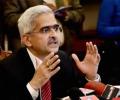
Reserve Bank Governor Shaktikanta Das has pitched for policy support from all sides -- fiscal, monetary and sectoral -- to nurture recovery of the economy hit by the second wave of the coronavirus pandemic. The dent on economic activity due to the second wave of the pandemic during April-May necessitated continuation of monetary measures to support the process of economic recovery to make it durable, Das had said while participating in the meeting of the Monetary Policy Committee (MPC) earlier in the month. "Overall, the second wave of COVID-19 has altered the near-term outlook, and policy support from all sides - fiscal, monetary and sectoral - is required to nurture recovery and expedite return to normalcy," Das said, as per the minutes of the meeting released on Friday.

Lenders had filed 1,251 cases to recover Rs 24,765.5 crore. Wilful defaulters are the entities that do not pay back money despite the ability to do so. Defaulters above Rs 1 crore were considered for this exercise.

The country's top FMCG stocks, such as Hindustan Unilever, ITC, Nestl, Britannia, Godrej Consumer Products, and Dabur, among others, are currently trading at around 41x their trailing 12-month earnings, down from their peak P/E multiple of around 48x at the end of December 2018.

Schuldschein is an alternative way to raise funds instead of loans or bonds and deals can run from $12 million to more than $1.13 billion. These instruments include tranches of different maturities and currencies and investors are spread across the world.

Glenn Maxwell blasted an unbeaten 113 from 55 balls to guide Australia to a seven-wicket win over India that sealed a 2-0 away T20I series victory.

Equity flows have been under pressure since the second half of 2018, after the IL&FS crisis sent shockwaves in both equity and debt markets.

Asian Development Bank on Wednesday lowered India's economic growth forecast for FY2019 to 5.1 per cent on slowing job prospects, rural distress exacerbated by poor harvest and credit crunch. Growth in FY2020 is likely to recover thanks to this support, low oil prices, and a weakening rupee, but risks to the projections remain tilted to the downside, it said on India.

'MFs acted as reckless lenders and not as prudent investors.' 'Clearly, how debt funds are being run is a systemic issue,' warns Debashis Basu.

IMF says, India will grow significantly in near-term.

The Pay Commission's award will provide a windfall that can be used to both spend and invest wisely.

Britain's 'remain' option gaining traction, with the implied probability of such an outcome at 78 per cent.

The fundamental debate remains where you stand on the long-term growth question. That is what every investor must monitor and come to their own conclusions, suggests Akash Prakash.

Listening -- really listening -- to advisers in the government and outside would help. India has plenty of wise economists who have worked within the bureaucracy during previous crises, points out Rahul Jacob.

According to the RBI's Financial Stability Report, the industry's gross bad-loan is at a 14-year high. As RBI's March 2017 deadline for banks to clean up soured credit looms closer, Shailajanand Mishra takes stock of just how bad the situation is.

The weakness in the rupee and broader markets has led to evaporation in the market cap.

The Centre has set a steep divestment target of Rs 80,000 crore for 2018-19. In the first six months, it has managed to mop up less than Rs 10,000 crore.
TCS, Wipro and Infosys dropped by up to 4.47 per cent, dragging down the BSE IT index by 2.96 per cent

'Modi was in as sweet a spot as is possible for an Indian prime minister in mid-term.' 'Why, then, did he plunge into this massive disruption?' 'The answer,' argues Ashok Malik, 'lies in a single word: Belief.'

On Monday, the biggest gainers in the Sensex pack were Sun Pharma, Bajaj Finance, Vedanta, Yes Bank, Tata Motors, HCL Tech, IndusInd Bank and Kotak Bank, HCL Tech, Infosys and Bajaj Auto.

Learning perhaps from the Kargil debacle, Musharraf tried hard to evolve as a statesman in his dealings with India, recalls Rana Banerji, who headed the Pakistan desk at RA&W.

Trading sentiment remained distinctly weak due to the cash crunch arising out of the government's move to demonetise Rs 500 and Rs 1,000 notes to flush out black money amid concerns about its impact on small and medium-sized businesses which largely run on cash.

Despite the 3 per cent gain in September 2019, the FPI sell-off during the quarter has seen the benchmark indices - the S&P BSE Sensex and the Nifty 50 register negative returns in Q3CY19.

In April, the inflows into equity schemes dropped 60% compared to the previous month to Rs 4,608 crore, the lowest since Sept 2016.

There will be uncertainty about outcomes,but one must hope for the best, observes T N Ninan.

The market last tumbled 10% or more in December 2016 following demonetisation. The decline was followed by a sharp rebound. This time the chances of such a v-shaped recovery are less.

'It is a game of patience. We have to stand firm and tire them out, which we are doing.'

Religion matters. Aspirational India is still poor. India admires strong leaders. India values decency. Shreekant Sambrani highlights the reasons why the BJP pulled off improbable victories in the Hindi heartland.

Balanced funds are generally equity-oriented with at least 65 per cent exposure to equities and the rest of the corpus invested in fixed income securities

Look at those offering 100-300 bps more and have good rating; it will improve your portfolio's returns.

All investment decisions can be distorted by your own biases. Understand your biases and make informed decisions.
India will need to 're-examine' and 're-negotiate' the trade access with the European Union and the United Kingdom which she noted may or may not be 'good' for India.

Global currency market sentiment is likely to be driven by the US deficit and debt ceiling negotiations, with markets likely to turn more risk averse closer to October 17, the date by which the US Congress must approve raising the country's borrowing limit.

Tech companies typically do lots of business overseas and book profits in low-tax jurisdictions.

The economy has shown sharp resilience in the past and has also bounced back in good time. We could hence expect a similar trajectory next year, observes Madan Sabnavis, chief economist, CARE Ratings.
RBI said aggregate demand during the year so far suggests that the shock to consumption is severe, and it will take quite some time to mend and regain the pre-COVID-19 momentum.

Movements in gold prices will depend on the US' interest rates.

When we are unwell, we consult a doctor, take a prescription, and then buy medicines from a chemist. In finance, too, it is best to keep investment advice and product purchase separate, suggests Bindisha Sarang.

A majority of economists predicted RBI Governor Raghuram Rajan would leave policy rates unchanged on Tuesday and expected a dovish commentary, as crude oil prices and inflation cool off.

Sources said much has been done to ease the tax burden of the middle classes in the last five years, and that such a measure affects only a limited segment of people when the focus should be to put money in rural areas. Archis Mohan reports.

It should cover mandatory expenses, insurance premiums and loan installments for six months to a year.
